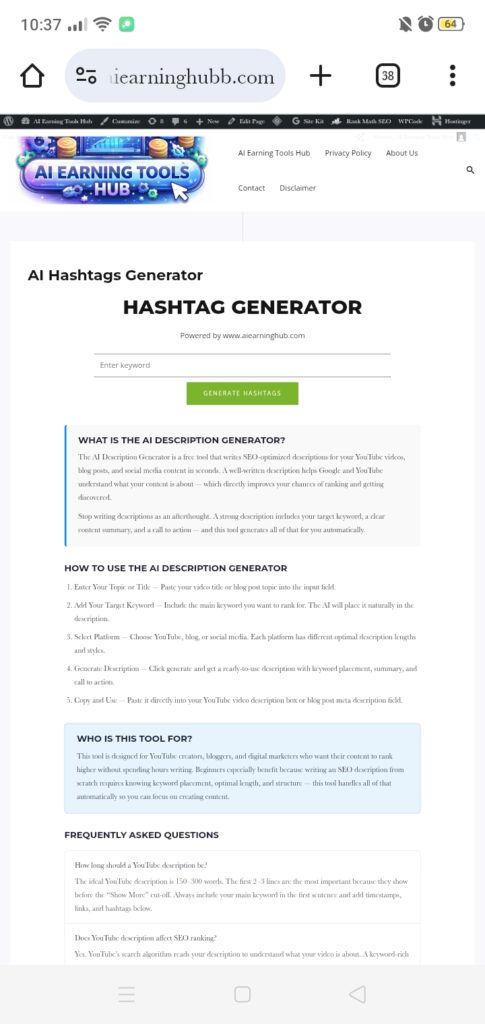
Hashtags haven’t disappeared — they’ve just gotten harder to get right. Platforms have changed how they weigh hashtags in their algorithms, audiences have grown numb to spammy tag-stuffing, and what worked in 2021 (30 generic hashtags crammed into a caption) can actually hurt your reach today. This guide breaks down exactly how hashtags function on today’s major platforms, and how to use our free AI Hashtags Generator to get relevant tags in seconds instead of guessing.
Why Hashtags Still Matter in 2026
Search-based discovery has quietly become more important than pure algorithmic feed distribution on most platforms. Instagram, TikTok, and Pinterest all now function partly as search engines — users type in what they’re looking for, and hashtags help surface relevant content. A well-chosen hashtag set acts as metadata that tells the platform who should see your post.
The catch is that “well-chosen” doesn’t mean “as many as possible.” Platforms have gotten better at detecting mismatched or irrelevant hashtags, and using them can quietly suppress a post’s reach rather than boost it.
What an AI Hashtag Generator Actually Does
A good hashtag generator doesn’t just pull from a static list of trending tags. It analyzes the topic, keywords, or description you provide and generates a mix of:
- Broad/high-volume tags — widely searched terms that put you in front of a large audience, but with more competition
- Niche/mid-volume tags — more specific terms with less competition, where your post is more likely to actually get seen
- Community or branded tags — terms tied to a specific audience segment or content style
The goal is a balanced mix, not a pile of the most popular tags on the platform. Ten million posts under #love isn’t doing your content any favors — it just disappears instantly.
Step-by-Step: How to Use the AI Hashtags Generator
- Open the tool. Go to the AI Hashtags Generator — it works directly in your browser, no signup required.
- Describe your content or paste your caption. The more specific you are, the more relevant the output. “Fitness” generates generic tags; “home workout routine for beginners over 40” generates tags that actually match your audience.
- Select your platform. Hashtag conventions differ between Instagram, TikTok, Pinterest, and X — tailor your set accordingly rather than reusing the same tags everywhere.
- Generate and review. The tool returns a mixed set of broad, niche, and community tags. A 10-second gut check catches anything off-topic before you post.
- Copy and paste into your post. Adjust the count to match platform norms below.
Platform-by-Platform Hashtag Strategy
| Platform | Recommended Count | Placement |
|---|---|---|
| 3–8 highly relevant tags | End of caption or first comment | |
| TikTok | 3–5 tags | In the caption, mixed with keywords |
| 2–5 tags | End of pin description | |
| X (Twitter) | 1–2 tags | Inline or end of tweet |
| 3–5 tags | End of post |
Notice the trend: fewer, more targeted hashtags consistently outperform large batches across every platform. If you’re still pasting 30 tags into an Instagram caption, that habit is likely working against you rather than for you.
Common Hashtag Mistakes to Avoid
- Using only high-competition tags. #love, #instagood, or #fyp put you in a pool with millions of posts — your content is buried within minutes.
- Reusing the exact same tag set on every post. Some platforms flag repetitive, identical hashtag blocks as spam-like behavior, which can quietly reduce reach.
- Ignoring relevance for reach. A trending but unrelated hashtag might get impressions, but it won’t convert to engagement, follows, or sales.
- Skipping niche tags entirely. Niche tags have less competition and a more targeted audience already interested in your specific topic — they often convert better than broad tags even with lower reach.
FAQ
Is an AI hashtag generator actually better than picking hashtags manually?
It’s faster and more consistent, especially if you’re posting across multiple platforms regularly. Manual research still has value for niche or highly specific audiences, but for day-to-day posting, a generator saves significant time while keeping tags relevant.
Do hashtags still affect reach on Instagram in 2026?
Yes, though their role has shifted more toward search and discovery than pure feed distribution. They still help new audiences find your content, particularly through Explore and hashtag search pages.
How often should I change my hashtag sets?
Rotate them regularly. Reusing an identical set post after post reduces effectiveness and can look repetitive to both audiences and platform algorithms.